Small planes have four options for flying up to Alaska. I remember just dreaming about flying to Alaska and now I realize I’ve done all four of the basic routes. Here’s a recap of each one:
Route 1. The coastal route.
I did this once in my T210. A wild and daring trip I must say. I started from Port Townsend in Washington and flew over the stunning coastline until clouds appeared, and I climbed up to 12K to be above them. I then ended that first day by doing a multi-leg darkening approach in the rain down into Ketchikan. I loved it (well, maybe after I landed I loved it) and it stands as one of the most memorable approaches I’ve done. As often said, it is a risky route because of the rocky, remote shoreline. Losing an engine isn’t something you want to dwell on too much. However I was alone and accepted the risk. Customs? Nope, never left the US.
The rest of the trip up north was spectacular, with mountains and glaciers, and more glaciers and mountains.

Route 2. The Al Can
Many pilots just follow the traditional Al Can highway up, but it isn’t the most direct route or in my opinion, the prettiest. Though some say it is the safest with more roads, more airstrips and more human activity. It may be important to note that for the last few years this route has been very smokey. The other routes are further west and don’t burn as much, though they do burn.

It is interesting to note that the Al Can route was chosen because it connected a string of airfields used for ferrying planes to Alaska and to the Soviet Union (as part of the WWII Lend-Lease program), not because it was the shortest route.
Route 3. The Trench
I like the trench. It is basically a big canyon starting in Prince George and ending at Watson Lake with about a 2,000 foot base and mountains on each side of 6-8,000 feet. I’ve flown it both ways now, up and down. It’s beautiful, remote (good and bad), and often allows you to dive under cloudy weather. It used to be more dangerous since there are a couple of sucker-canyons that have apparently claimed a few planes. Now, however, just follow the magenta line. And have GPS backups.
Note that there is a 3,500 foot pass you must climb over in the trench. It isn’t high, but with really low weather that may be an issue.
It is remote, and I did lose power above the incredibly long and desolate Williston lake for one or two seconds on my last trip. That was scary. After a low power mag check and playing with some things I was thinking it was water in the gas. It had rained hard in Williams Lake, and we had just hit some rough turbulence, which can stir the water up. This also happened years ago in the T210 and it felt the same. The next time I checked the fuel I rocked the wings aggressively (I have fuel bladders and water can become trapped in the folds) and sure enough got some water in the test-cup. A few days later when in Wasilla I went to the very handy local Aircraft Spruce store and bought new fuel cap gaskets and that did it.
Graeme and I thought it was funny that the woman at MacKenzie said it was a three day weekend so we should see a lot of boat traffic on Williston Lake. The lake is 150 miles long and we saw three boats.
I was a little nervous about having enough fuel in the Trench but if you stop in Mackenzie for fuel (Instead of Prince George) there really isn’t a problem. It is always a good idea to call ahead. I call ahead a lot on these trips. I did see a photo on the web of big-tire bush planes filling up from gas cans after intentionally landing on one of several emergency landing strips in the trench.

Route 4. The Cassiar Highway
This shorter route was an option for building a highway from Canada to Alaska but the traditional Al Can route, much further east, won out when the first road was built in WWII.
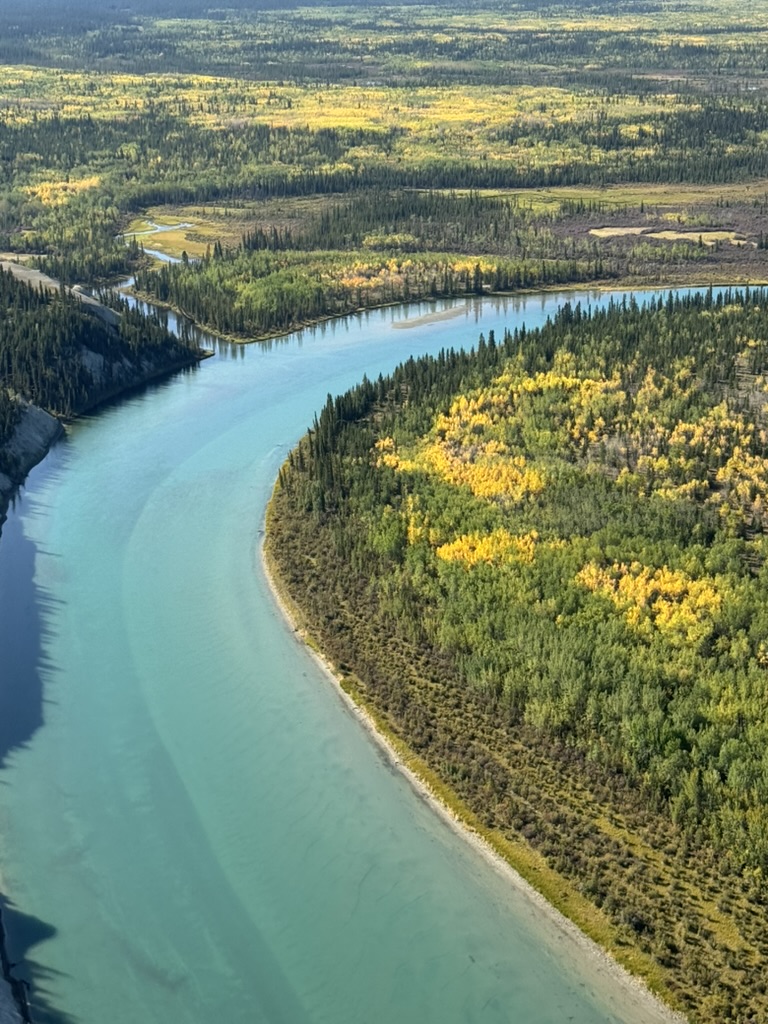
This is probably the shortest route and also the most diverse, with endless forest but also surprisingly arid sections as well as agricultural fields.
I’ll probably fly the Cassiar route flying one way and the Trench going the other way on my next trip north. One of the best things about the Cassiar route is the chance to stop in Stewart BC / Hyder AK, a fantastic side trip on the way to, or from Alaska. More on that later.
If you plan to camp under the wing there are better options on this route since the airports are small and generally very quiet and informal.
One year I flew up via Nanaimo (customs) near Vancouver and up to Squamish for some fantastic rock climbing and mountain biking. Call ahead to land there as there wasn’t much ramp space. Or runway length. Then the flight up past Whistler and out east to meet the Cassiar route was stunning.
 West Coast Flying Adventures
Very interesting, thanks for posting! Would love it if you’d post a map with the different routes and stops at some point.
Hi – that’s a good idea, I’ll try to get around to doing a map.
Ney, curious if you have installed an autopilot in the 182? Looks like you or the previous owner updated the avionics a bit and I’m curious of your capabilities and how you like the ship? I’m in pre-buy for a 1964 182G, similar to yours but mine hasn’t been updated at all. Whole panel is old as the hills. Someday you’ll need to do write-up on the website for the 182, like you had done on the 210 🙂
I did put in an autopilot. A King Trutrack – kind of a cheapy, but it works. I did a lot of it myself, and it took me a considerable amount of time. Considerable.
It was nice having it enroute to and from Alaska although I would probably rank it even with having a STOL kit and larger tires, which I don’t have.
Yes, I’ll have to do a post on the 182. It treated me very well for the 70 hours I put on it in Alaska.